
Integrating a Power Bank GC600

markab

markab

VIP Member
Messages
159
Location
Suffolk, UK
Vehicle
Grand California 600
I have done a fair bit of reading through the forums on Power Banks and integration, I would like to increase the capability of our 600 by a day or so, I considered solar but it seems to be a bit of a pain on the 600. Really we are never off grid for more than a couple of days. I also contacted a supplier around fitting a LifePO4 and a split charger but the quotes for that are north 3000.

What I intend to do for now is install a victron filax 2 auto change over and integrate it with a DJI power 2000 which has a 3000w inverter. EHU will be connected to the primary on the filax and the power bank 230 output to the secondary of the filax, the load port from the filax will then supply the 230 consumer unit in the GC600. A second feed will be taken from the EHU before the filax and will be connected to the charge port of the power bank. I will add an isolator switch on the supply to GC600 charger and on the Power Bank charge feed.

Under basic operation when on EHU, EHU will supply the Van and charge both the GC battery and the Power Bank charger. When EHU is disconnected the filax will auto switch to the power bank 230 supply, the power bank will not be charged as it was fed from the EHU. I can then decide if I would like the power bank to feed the GC charger or just supply the van.

I think I can achieve this with the Filax a couple of isolation switches, some wago connectors and some flex so the whole thing is pluggable without the need to modify the GC wiring.

Anyone used a filax to achieve this?

Screenshot 2025-09-24 at 08.33.09.png
 
Although thinking about this the DJI Power has UPS mode with auto switchover and supplies the 230 output from grid power when connected to the grid. So actually all I need to do is create 2 cables with wago connectors to insert the power bank between the consumer unit and EHU?

Screenshot 2025-09-24 at 10.09.55.png
 
possibly put a 16 amp breaker between the EHU and the power bank...
 
I have a similar quandary…
I have re wired the EHU to the 240v charging input to a EcoFlow power bank. I’ve then put a 13A plug on the EHU wire going to the van system and plugged this into the power Bank 240 V power bank output. This works to a fashion. But there is a problem.

When hooked up to mains power, everything is fine. The mains charge the power bank and the output from the power bank charges the leisure battery in the van. So far so good

But then when you disconnect the main power, then the power pack charges the leisure battery which then powers the van systems. So what you end up with is a battery charging a battery. Obviously this is very inefficient. I get about a 24 hour run of a 4 kWh power pack.

I’m sure there’s got to be a better way. And way that doesn’t involve constantly switching things on and off.

Is there some way you can connect a 240 V output from the power pack to the van electric system so he doesn’t charge the leisure battery but then powers both are 12 and 24 V systems.

To be honest, I have considered just removing or disconnecting the van leisure battery entirely.

If anyone can suggest an alternative, then I’m all for it. But please make it relatively simple. By this, connect it there, job done.
 
Yes & No. It’s possible and fairly simple to just supply the vans 13A outlets. There are a bank of Wago connections under the consumer unit in the utility cupboard behind the panel. Just unscrew those panels for access. Here is a file that covers how to create a change over panel that gives a bit more detail on those connectors.

I would say using 4kWhr in 24hrs suggests something more than the EHU battery charger loading your power station. The charger as you say charges the leisure battery and also charges the starter battery so I agree its not a particularly efficient use of a power station.

Supplying the 12V without charging the battery is more involved but again possible. I’ve also attached a file that outlines one possible method.
 

Attachments

  • ChangeOverSwitch_Simple.pdf
    1.4 MB · Views: 36
  • USB-C Leisure Battery Support Issue 1.pdf
    2.4 MB · Views: 32
Last edited:
Yes & No. It’s possible and fairly simple to just supply the vans 13A outlets. There are a bank of Wago connections under the consumer unit in the utility cupboard behind the panel. Just unscrew those panels for access. Here is a file that covers how to create a change over panel that gives a bit more detail on those connectors.

I would say using 4kWhr in 24hrs suggests something more than the EHU battery charger loading your power station. The charger as you say charges the leisure battery and also charges the starter battery so I agree its not a particularly efficient use of a power station.

Supplying the 12V without charging the battery is more involved but again possible. I’ve also attached a file that outlines one possible method.
Thanks for the document very helpful and yes similar to what I was considering.

So in this config I assume that the Power Bank would also be powering the Leisure battery charger? and while not exactly efficient I think along with a full leisure battery should get me 2ish days off grid for those odd occasions I need it.

Any reason not to go with an Auto change over switch something like...

 
There are two options in the change over switch document. One that powers the entire GC which would include the EHU battery charger. The other that only powers the socket outlets so does not power the EHU charger.

An ATS would work.
 
Last edited:
There are two options in the change over switch document. One that powers the entire GC which would include the EHU battery charger. The other that only powers the socket outlets so does not power the EHU charger.

An ATS would work.
Thanks!

Do you have the part/model of the din enclosure you used. And can you share the 3d print file, I don't do FB!

Thanks for the help!
 
I originally did as per Gordon with manual switch but have swap this for an ATS. I will take some pics etc and give bit more info on my current set up if that helps.
 
I originally did as per Gordon with manual switch but have swap this for an ATS. I will take some pics etc and give bit more info on my current set up if that helps.
Thanks would be great.
 
Thanks would be great.
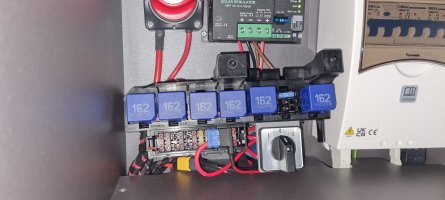
Hi sorry fo delay currently travelling. Pics of my setup attached. This is set up using Gordon’s manual switch and 15a instruction but I have swapped out the manual switch for an ATS. This means whenever I plug in ehu it just switches over and if I turn on ac output on EcoFlow it switch to that if no ehu connected. Plus I have used 3phase unit so I have spare contacts I use to run power charging EcoFlow when on ehu. If you need more info let me know I do plan on doing full write up when I get chance.

View attachment IMG_5992.jpeg

IMG_5991.jpeg
 
Hi Folks,

I'm going a slightly different route as I don't require power to the 230v habitation sockets, just an extra day or two from the batteries.

I'm placing a DJI power bank 1000 V2 ( no affiliation, just what I have) in the boot area under the external shower. It should also fit into the cupboards under the bed.

Inputs:

The 230v charging cable is plugged directly into the 230v socket in the boot. When the van is on EHU the power bank fully charges in 1 hour. This makes for convenient charging.


Also a 12v cigarette charger is plugged into the 12v socket in the boot. A voltage sensing relay is used to ensure this only gives an output then it is above 13.6 (i e the van is running). This trickle charges the power station at a maximum of 100W while driving, the fridge uses around 30W/hr... So around 70W into the battery/hr while driving. That's 14.5 hours driving to charge the battery from 0 to 100%. This is obviously not practical so you need to ensure you leave the house with a fully charged power station. This way you should still arrive on site with the battery at 100%.

Output;
For the output I plan to use the 12v on the power station.
I will remove the fridge fuse (15amp, position 2) in the technical cabinet, and place the 12v feed from the power bank into the take off side (lower pin) of the fuse holder at position 2 using an electrical spade. To maintain electrical protection to the fridge I will install an inline 15 amp fuse.

In this manner the power station runs the fridge and only the fridge. My ambient temperatures are not that hot, and I should get 3 days from the fridge. Driving for an hour will add around 2 hours of fridge run time, not brilliant, so you ideally need to plug into HU after 2/3 days.

Now that the AGM battery is liberated from the fridge it will power the lights for a few days (as long as it's not illuminated like a Christmas tree). I have solar, so on good days (without the fridge running) the battery is back to 100% by evening anyway.

If I need 230v (which I never do) I could take it from the power station, nothing that it will drop fridge run time.

The other advantage for me is that we use our camper at sporting venues over long weekends. It's very simple to unplug the two inputs and one output from the power station and bring it into the venue, an hour later it is fully charged and ready for another couple of days if needed.

I intend to put a manual change over switch on the 12v supplying the fridge, so I can swap between the AGM to fridge or the power station to fridge. This just gives me options if the power station is low and the AGM is high, or if the power station has been temporarily removed.

One of the advantages of this is that you are not interfering with any of the original wiring, everything is reversible. You are not discarding the AGM battery, not having to worry about lithium in the engine bay, you have the use of a power station for other applications at home etc. and it's 'relatively' cheap. Power station with car kit costs me €620 euros.

I will report back towards the end of November with pictures and results.
 
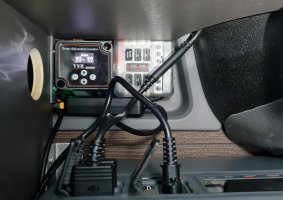
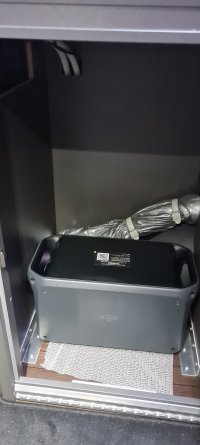
Just a quick update on my install... The DJI Power 1000v2 is now installed. Please see photos attached. I ran the fridge just in the power station and it ran for 60 hours. However, this was over a cold period, the van was not heated and the fridge was only opened a handful of times. I will give it a proper field test shortly. I plan to run the fridge and other auxiliaries on the original leisure battery at night, this is to deplete the battery so I will have somewhere to sink the solar voltage during the day. During the day my lights will be off, most probably the heating, and I will run the fridge off the power station. That will means that the existing leisure battery will not have any draw during the day and will be recieving and storing all the energy from the solar panel. During a good sunny day I hope this will top back to the battery to full percentage. The power bank should be able to keep the fridge going for at least 36 hours (3 x 12 hour days). At the end of this period I (depending on sunshine) would hopefully still have a full leisure battery that can take me another circa 48 hours on its own... But the proof will be in the use.

In terms of installation it could not be easier. 1 wire and 1 fuse...I tapped a second ground wire from the solar charger regulator (battery - terminal), this is just to peg the power station 12v to the leisure battery 12v (without the common ground they can float apart). Alternatively you could use a chassis point for this, but in general this is not used in modern vehicles as it can prompt rust and cause bad earth issues. The second thing you need to do is remove the 15 amp fuse for the fridge and install a fuse tap. In this you only place a fuse in the top holder, this will be fed into a changeover switch. The second feed into the changeover switch is from the 12v output of the power station (again this is fused with 15 amps). The output from the switch is fed into the bottom lower connection on the fuse tap. This provides power to the fridge. The fridge will use it's existing ground.

To charge the unit I ran a mains cable from the rear 230v socket to the power bank, and also a 12v (100w) car charger to the power station. The car charger for DJI turns off at 12v and is not adjustable, this is too low for the leisure battery so I installed a simple voltage sensing relay. This turns on at 13.3v and turns off at 13.1v, thus preventing discharge of the leisure battery into the power station. The advantage of this, is that when the leisure battery reaches above 13.1v on solar or will also start to top back up the power bank. TBH, I do not expect much if any solar into the power station, as the solar could not keep the leisure battery top up on its own, let alone adding a second battery.

The advantage of the system.
1. Relatively chip at 650 euro
2. Very easy to install.
3. Keeps all original wiring standard.
4. Can be reverted in 30 seconds.
5. Should keep the camper off grid for circa 4 days.
6. Power station can be fully charged in 1 hour (by plugging the camper into shore power or removing the power station and charging remotely).
7. Access to moderate amount of 230v electricity if needed (I don't).
8. Fast charging USB devices - 100W.
9. Temporary power supply for house during blackout.

Disadvantages:

1. 650 euro..a 100k camper should have better system from factory.
2. Additional 15kg, payload on GC is shocking low to start with.
3. It takes up a not insignificant amount of space in the cupboard.
4. General LiPo risks (at least this one has 19 temperature sensors and 24 fuses for safety, so I'm not concerned).
5. I will be powering off the fridge each time I change between leisure battery and power station supply, while this is probably not required it eliminated the possibility of a current surge on changeover.

20251221_145913.jpg

20251221_144737.jpg

20251221_150153.jpg
 

Similar threads

G
Replies
3
Views
698
Gareth Salton
G
C
Replies
45
Views
8K
Carryon Cali Camping
C
markab
Replies
0
Views
216
markab
markab
Back
Top