
Parking heater: 1-10

acer

acer

VIP Member
Messages
1,048
Location
North Hertfordshire
Vehicle
T6.1 Ocean 150
I’m in the van with auxiliary heater on. I’ve plenty of diesel and electricity.
Using “heat continuously” I can always generate instant heat by selecting level 10. However, if I select say level 7, as I just did, I can wait an hour and nothing happens. Conversely, yesterday the heater was on overnight on level 3 and came on and off regularly throughout the night as desired. The manuals don’t really explain how to use the parking heater, other than which buttons to press. So, what am I doing wrong? How do I know what number to select to make the thing work, other than by guessing and increasing by one each time? Or, do I just put it onto level 10 until it’s a furnace in here and turn it off? Is any of this sounding familiar to anyone or, is there a problem with my parking heater.
That feels like a lot of rambling, but hopefully this makes clear the issue.
 
I read somewhere the temperature sensor is in the door footwell, perhaps that's blocked/not working?
 
I read somewhere the temperature sensor is in the door footwell, perhaps that's blocked/not working?
Thanks for the quick reply. Don’t worry, by the way, this isn’t an emergency situation.

The two grills in that area are clear and the heater was coming on and off on level 3 last night (although it was about 5 degrees).
 
There’s probably nothing wrong with your heater.

From the digging I’ve done, for the T5 Cali, the air temperature sensor for the diesel heater is in the air intake in the right front footwell at the entrance step. I’ve no reason to think it was moved for the T6 or T6.1. If others know better please correct me!

So I guess if you’ve been driving with the cabin heater turned up, it could take a while for the air temperature to even out. As per post #4 by @Kimbo the diesel heater won’t kick in until the air temp drops below the relative setpoint. For us, we often set to 7, or 21degC during the early morning/ evening, then 2, or 14degC during the night if we think the outside is dropping to frost levels.

Maybe try opening the drivers door to chill the sensor, and see how that goes?

Hope this assists you.
 
I don’t believe there is a “separate “ intake temp sensor external to the the one that’s integral to the heater unit.

I’ve physically searched for it and been through the wiring schematic on Erwin and the only one shown for intake temp is part of the Eberspacher control unit inside the heater.

The reason I’ve searched for it is because, disconnecting it forces the unit to default to its own internal intake sensor and I wanted to experiment to see if the control loop behaves differently.

Anyway, I digress. Given our current UK ambient, setting 7 should definitely fire up. I ran mine at 4 last night before bedtime.
 
As various have said above the heater acts more or less the same as your house one. You set the temp and it comes on and off to try and maintain that temperature. Like your granny used to, if you turn it to max it definately comes on, but just gets hotter and hotter.

The challenge we have found over the years is that it’s not as nuanced as the house, so it swings quite a lot between when it switches on and off. So it can get chilly, on, red hot, off, repeat, rather than clicking on and off constantly like the house.

We tend to turn it up to “force” it on when it get’s too cold and then turn it down when the inside reaches the desired temp (we have a cheap thermomenter that sits on the glass tops).

Then through the night we leave it at 6 or 7 depending on the time of year (or off in summer).
 
Thanks very much everyone. That definitely helps. We are in Verdon Gorge at the moment, at modest altitude at times and so the temperature range is quite large from day to night. The perfect opportunity to become accustomed to the heater.
 
As an aside, I’ve been looking at the output grill. Its design is ridiculous with almost 40% being complete blockage. Take it out and examine the rear side. The slats are thick and with a bluff face.
The onset airflow just crashes into a flat surface.

To my mind this will only cause back pressure and subsequent heat build up in the supply duct forcing the heater to run hotter than it needs to and therefore shutdown earlier than it should.

Switch the heater on full and hold a sheet of kitchen paper approx 600mm from the duct.
Absolutely zero air flow.
Remove the duct altogether, the kitchen roll flys like a flag in a gale.

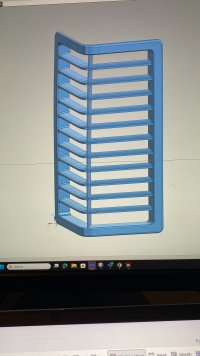
I’ve modelled up a new more aero friendly version in CAD.
Early testing shows vastly improved airflow.
I’m struggling to get a material to cope with the heat.
Work in progress.
 
This actually has aerofoil shaped slats angles differently from the original.
 
Nice work sidepod!

I read Polycarbonate (PC) filament can go up to 100 degrees. Maybe try that? Never used it myself though.
 
Nice work sidepod!

I read Polycarbonate (PC) filament can go up to 100 degrees. Maybe try that? Never used it myself though.
Ok cool. My printer guy supplies JLR so I’ll pass that on :cheers
 
Back
Top